
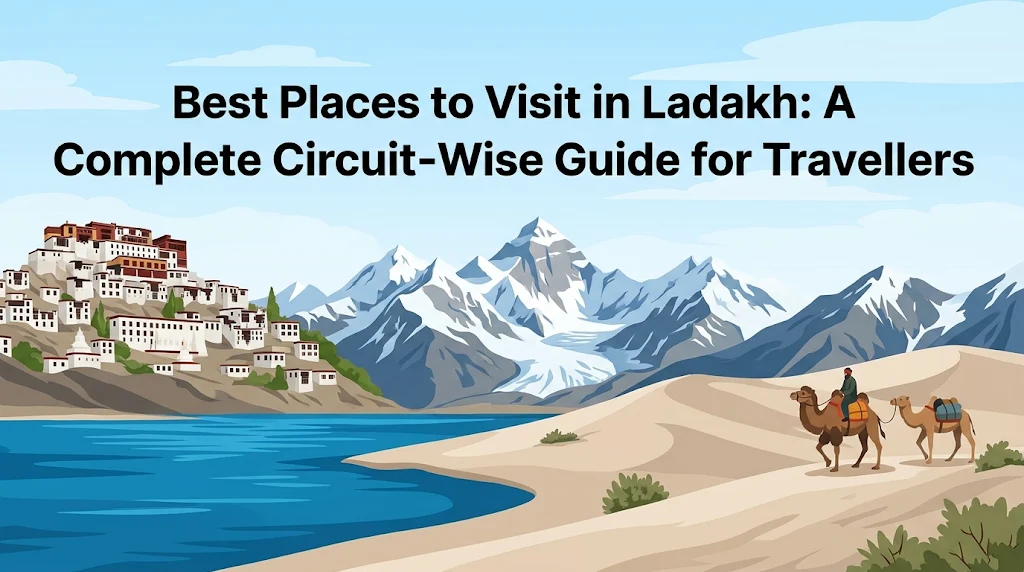
The best places to visit in Ladakh are Pangong Tso, Nubra Valley (Hunder and Diskit), Leh Palace, Shanti Stupa, Magnetic Hill, Khardung La, Tso Moriri, Hanle, Turtuk, and Zanskar Valley. Because Ladakh has rough mountain roads and high altitudes, the easiest way to plan your trip is by dividing these spots into four main travel circuits: Leh & Sham Valley, Nubra Valley, Changthang (Pangong & Hanle), and Kargil-Zanskar.
Key Takeaways
- Plan by circuit, not distance: A 150 km drive in the mountains of Ladakh easily takes 5 to 6 hours because of high mountain passes and bumpy roads.
- Acclimatise first: Spend your first 48 hours in Leh (11,500 ft) visiting nearby spots like Sham Valley before you head up to high passes like Khardung La.
- Permits are a must for restricted areas: Indian citizens must pay the Environment and Red Cross Fee online on the official Leh Administration portal before visiting places like Nubra, Pangong, Tso Moriri, and Hanle.
- Carry cash and use a postpaid SIM: Prepaid SIM cards issued outside Ladakh and Jammu & Kashmir generally do not work in the region. Also, ATMs and UPI apps do not always work outside Leh town, so keep cash handy.
- Peak vs. shoulder season: June to September gives you clear roads everywhere. May and October bring fewer crowds and beautiful snow views, but some routes may be cold or tricky.
Ladakh is a high-altitude cold desert in northern India famous for dramatic mountain views, bright blue glacial lakes, old Tibetan Buddhist monasteries, and some of the highest motorable roads in the world.
For Indian travellers, planning a trip to Ladakh takes more than picking a few nice spots on a map. The height changes quickly between valleys, the weather shifts without warning, and the roads are maintained by the military. Here is a simple, circuit-wise guide to the best places to visit in Ladakh so you can plan a safe and smooth trip.
Quick Comparison: Top Places to Visit in Ladakh
| Destination | Circuit | Altitude (Approx.) | Distance from Leh | Permit / Fee Required? | Best Known For |
| Leh & Sham Valley | Central | 11,500 ft | 0 – 70 km | No | Acclimatisation, monasteries, Sangam |
| Khardung La | Nubra | 17,582 ft | 39 km | Yes (Green Fee) | High motorable mountain pass |
| Nubra Valley (Hunder) | Nubra | 10,000 ft | 125 km | Yes | Cold desert sand dunes, Bactrian camels |
| Turtuk | Nubra | 9,846 ft | 205 km | Yes | Balti culture, apricot orchards, border village |
| Pangong Tso | Changthang | 13,862 ft | 160–225 km | Yes | Colour-changing high-altitude lake |
| Hanle | Changthang | 14,764 ft | 255 km | Yes | Dark Sky Reserve, Indian Astronomical Observatory |
| Tso Moriri | Changthang | 14,836 ft | 220 km | Yes | Quiet alpine lake, migratory birds |
| Zanskar Valley (Padum) | Kargil-Zanskar | 12,037 ft | 460 km | No | Remote gorges, Phugtal Monastery, river rafting |
1. Leh & Sham Valley Circuit (Best for Days 1 & 2)
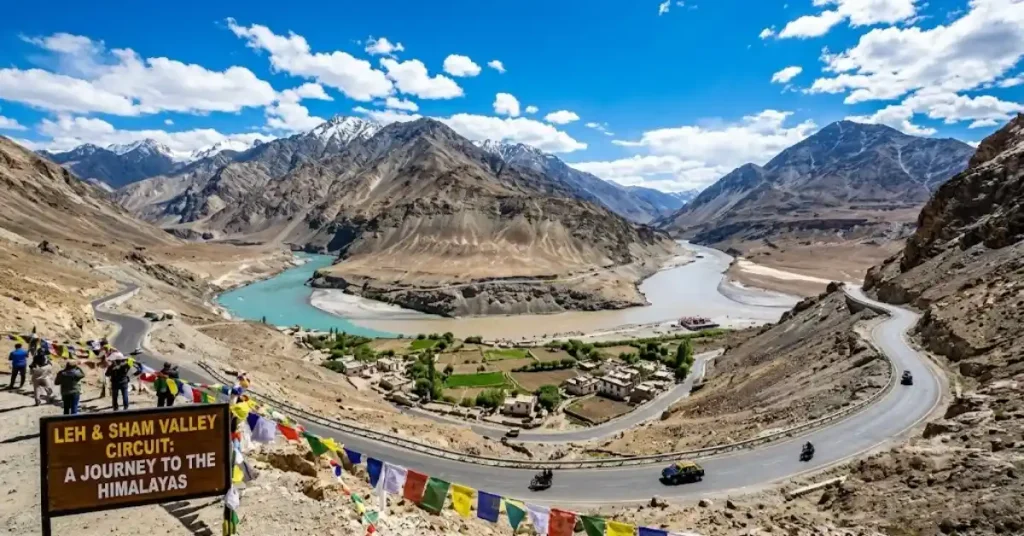
A historic 17th-century royal palace offering beautiful views of Leh town and the surrounding mountains. Explore its traditional architecture and historical exhibits
Leh Palace & Shanti Stupa
A beautiful white-domed Buddhist monument built on a hilltop. It offers panoramic views of Leh and is particularly attractive during sunrise and sunset..
Hall of Fame
Run by the Indian Army near the Leh airport, this museum honours the soldiers who fought in the wars with Pakistan, especially the 1999 Kargil War. It has great displays about Siachen Glacier operations, old weapons, and local Ladakhi culture.
Sangam (Indus–Zanskar Confluence)
Witness the beautiful meeting point of the Indus and Zanskar rivers. The contrasting colours of the two rivers create a spectacular natural view.
Magnetic Hill & Gurudwara Pathar Sahib
Just before Sangam, Magnetic Hill is a spot on the Leh-Kargil highway where an optical illusion makes cars in neutral look like they are rolling uphill. Nearby is Gurudwara Pathar Sahib, built in 1517 to mark Guru Nanak Dev Ji’s trip to Ladakh. Indian Army jawans serve hot langar here to travellers.
Best Time to Visit Leh & Sham Valley
- May to September: Generally the best period for sightseeing, road trips, and exploring monasteries.
- October to April: Colder months with possible snowfall and challenging road conditions.
Ideal Duration
2–3 days are recommended to explore Leh and Sham Valley comfortably.
How to Reach
- By Air: Fly directly to Kushok Bakula Rimpochee Airport in Leh.
- By Road: Reach Leh via the Manali–Leh Highway or Srinagar–Leh Highway, subject to seasonal road conditions.
- Local Transport: Hire a taxi, rent a motorcycle (if experienced), or arrange a local sightseeing tour.
Important Travel Tips
- Spend at least 48 hours acclimatising in Leh before travelling to higher-altitude destinations.
- Drink enough water and avoid strenuous activities during the initial days.
- Carry warm clothes, sunscreen, sunglasses, and basic medicines.
- Check the road conditions in advance before travelling to remote destinations.
- Respect local customs and monastery rules.
2. Nubra Valley & Shyok Circuit
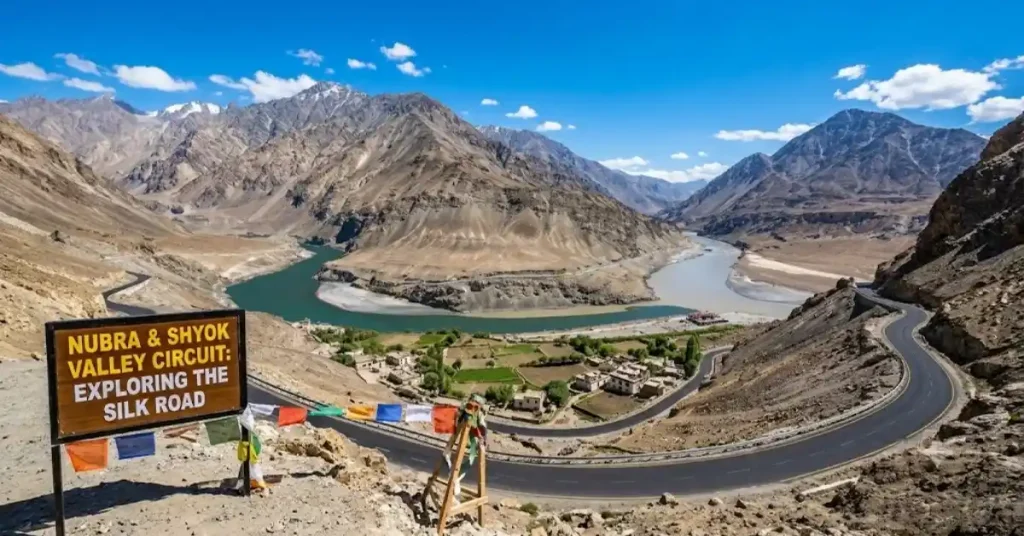
Nubra Valley lies north of Leh, where the Shyok and Nubra rivers converge. Even though it is high up, the valley floor is lower than Leh, making it greener and warmer in summer.
Khardung La
To get to Nubra from Leh, you drive over Khardung La. It is among the world’s highest motorable mountain passes. Because there is very little oxygen here, travellers are advised not to stay at the pass for more than 15 to 20 minutes.
Diskit Monastery & Hunder Sand Dunes
Diskit: Home to the oldest monastery in Nubra Valley and a massive 106-foot statue of Maitreya Buddha looking out over the Shyok River valley.
Hunder: Known for its silver sand dunes framed by snowy peaks. You can take a ride here on double-humped Bactrian camels, which are left over from the old Silk Route trading days.
Turtuk & Thang
Turtuk sits about 80 km past Hunder, close to the Line of Control (LoC). It was part of Pakistan-administered Baltistan until the Indian Army took control in 1971. Unlike Buddhist-majority Leh, Turtuk has a distinct Balti Muslim culture with stone paths, wooden homes, and gardens full of apricots and walnuts. A short drive further brings you to Thang, the northernmost village in India that tourists can visit. Through binoculars, you can spot Pakistani army posts across the valley.
Best Time to Visit
The best time to visit Nubra Valley is generally May to September, when road conditions are more favourable and outdoor activities are accessible.
| Month | Travel Experience |
|---|---|
| May–June | Pleasant weather and beautiful mountain scenery |
| July–August | Green valleys, flowing rivers and peak tourist season |
| September | Clear skies and fewer crowds |
| October–April | Cold weather and possible road closures due to snowfall |
Ideal Duration
2–3 days are recommended for exploring Nubra Valley and the Shyok Circuit.
- Day 1: Leh → Khardung La → Diskit → Hunder.
- Day 2: Hunder → Turtuk → return to Nubra.
- Day 3: Explore Panamik or travel via the Shyok route, depending on road access and your onward itinerary.
How to Reach Nubra Valley & Shyok Circuit
- By Road: Travel from Leh through Khardung La Pass to reach Diskit and Hunder. The journey takes approximately 4–5 hours, depending on road and weather conditions.
- Shyok Route: The Shyok road provides an alternative connection between Nubra Valley and the Pangong Lake region via Agham, Shyok and Durbuk.
- Local Transport: Hire a registered local taxi or arrange a sightseeing package from Leh.
Permit and Entry Fee Requirements
Visitors should arrange the applicable environmental and wildlife fees through the official Leh District permit portal before travelling.
- Carry valid government-issued photo identification.
- Check the latest circuit permissions for Nubra, Turtuk and other restricted areas.
- Foreign nationals and certain passport holders may have additional permit requirements.
3. Changthang Plateau Circuit (Lakes & Stargazing)
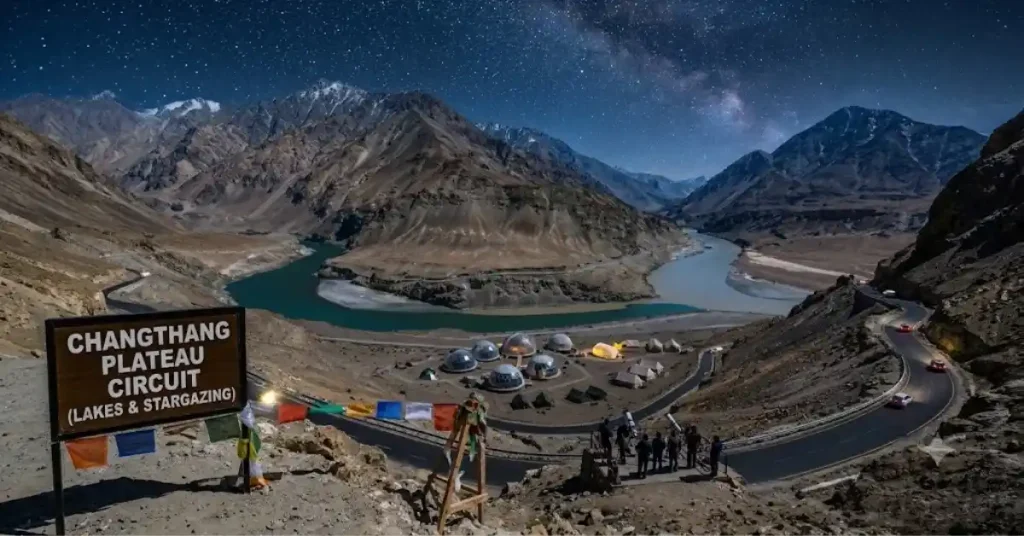
The high-altitude Changthang Plateau is located to the east of Leh. It is home to nomadic Changpa herders who raise Pashmina goats, salty lakes, and India’s top dark-sky sanctuary.
Pangong Tso
Pangong Tso is one of Ladakh’s most famous attractions, known for its stunning blue water and dramatic mountain surroundings. The lake changes colour throughout the day, creating beautiful views for photographers and nature lovers.
Hanle (India’s First Dark Sky Reserve)
Hanle is famous for its clear night skies and the Indian Astronomical Observatory. It is an excellent destination for stargazing, astrophotography, and experiencing the peaceful lifestyle of a remote Himalayan village. Hanle is also recognised as India’s first Dark Sky Reserve
Umling La
For road-trip lovers, Umling La was built by the Border Roads Organisation at over 19,000 feet and holds the Guinness World Record for the highest motorable road. You can visit it as a day trip from Hanle, but be ready for freezing cold and thin air.
Tso Moriri & Tso Kar
If Pangong Tso feels too busy, Tso Moriri near Korzok is a quieter wetland area surrounded by 6,000-metre peaks. It is a key nesting ground for migratory birds like the black-necked crane and bar-headed goose. On your way back to Leh via the Manali-Leh highway, you will pass Tso Kar, a salty lake where you can spot wild Tibetan asses called kiang.
Best Time to Visit Changthang Plateau Circuit
The best time to explore Changthang is generally from June to September, when road access and weather conditions are more favourable.
| Month | Travel Experience |
|---|---|
| May–June | Beautiful lake views and cooler weather |
| July–August | Better access to remote villages and lakes |
| September | Clear skies and excellent stargazing conditions |
| October–April | Extremely cold weather and possible road closures |
Ideal Duration
4–5 days are recommended to explore the Changthang Plateau comfortably.
Suggested itinerary:
- Day 1: Leh to Pangong Tso via Chang La; enjoy the lakeside scenery.
- Day 2: Pangong region to Hanle via the authorised route; explore the village.
- Day 3: Enjoy stargazing in Hanle and explore the surrounding landscape.
- Day 4: Hanle to Tso Moriri via the permitted route; visit Korzok village.
- Day 5: Return to Leh via Chumathang and Upshi, depending on road conditions.
How to Reach Changthang Plateau Circuit
- By Air: Fly to Kushok Bakula Rimpochee Airport in Leh. From there, arrange a local taxi or private vehicle.
- By Road: Travel from Leh towards Pangong Tso via Chang La or reach Tso Moriri and Hanle through Upshi, Chumathang and Nyoma.
- Local Transport: A 4×4 vehicle with an experienced local driver is recommended for remote routes and challenging road conditions.
Permit and Entry Fee Requirements
Some Changthang destinations fall under regulated travel circuits.
- Domestic tourists should check the applicable environmental and wildlife fee requirements.
- Foreign tourists may require an Inner Line Permit or additional Protected Area Permit, depending on nationality and passport category.
- Hanle and routes towards the border areas may have additional access restrictions.
- Carry valid identification and keep permit documents available at checkpoints.
4. Kargil & Zanskar Valley Circuit
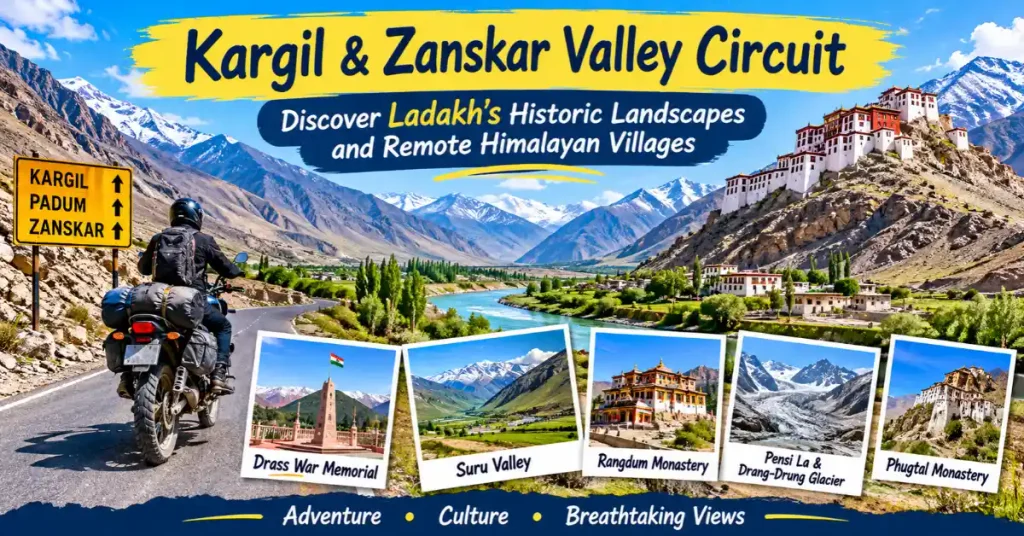
Western and southern Ladakh feature deep river gorges, war memorials, and remote Buddhist sites that get far fewer tourists than the main Leh-Nubra-Pangong route.
Kargil & Drass War Memorial
Situated along the Srinagar–Leh Highway, Drass is known as the world’s second-coldest inhabited place. The Kargil War Memorial at the foot of Tololing honours Operation Vijay (1999) and lets visitors look closely at Tiger Hill and Tololing peak.
Zanskar Valley (Padum, Gonbo Rangjon & Phugtal)
Heavy snow cuts off Zanskar Valley for nearly half the year. You can reach it through Kargil or via the newly opened Nimmu–Padum–Darcha (NPD) road. Top sights include:
Gonbo Rangjon: A sacred, standalone rock peak rising sharply from the ground near Kargyak.
Phugtal Monastery: An amazing monastery built directly into the side of a cave cliff, reached by a scenic walk along the Tsarap River.
Drang-Drung Glacier: One of the biggest easy-to-see glaciers in Ladakh, viewable right from the Pensi La mountain pass.
Best Time to Visit Kargil & Zanskar Valley
The best time to explore this circuit is generally from June to September, when mountain roads are more accessible and the weather is suitable for sightseeing and trekking.
| Month | Travel Experience |
|---|---|
| May–June | Snow-covered mountains and opening seasonal roads |
| July–August | Best for road trips, trekking and sightseeing |
| September | Clear mountain views and fewer tourists |
| October–April | Extremely cold weather and major road closures |
Important: The Pensi La route to Zanskar is generally closed from November until around mid-June due to snow. Check local road updates before travelling. India+1
Ideal Duration
5–7 days are recommended to explore Kargil and Zanskar Valley comfortably.
Suggested itinerary:
- Day 1: Reach Kargil and explore the local market and nearby attractions.
- Day 2: Visit Drass War Memorial and explore the Drass Valley.
- Day 3: Travel through Suru Valley and visit Sankoo and Parkachik.
- Day 4: Explore Rangdum Monastery and enjoy views of the surrounding mountains.
- Day 5: Cross Pensi La Pass, admire Drang-Drung Glacier and reach Padum.
- Day 6: Visit Karsha Monastery, Sani Monastery and nearby villages.
- Day 7: Explore Gonbo Rangjon or plan a trek towards Phugtal Monastery, depending on available time.
How to Reach Kargil & Zanskar Valley
- By Air: The nearest major airports are Srinagar and Leh. Both require further road travel to reach Kargil.
- By Road: Kargil is approximately 220 km from Leh and around 200–220 km from Srinagar, depending on the route.
- Kargil to Padum: Zanskar’s main town, Padum, is approximately 240–250 km from Kargil by road.
- Local Transport: Hire a local taxi or arrange a private SUV for exploring remote mountain routes.
The road journey to Zanskar depends heavily on seasonal access through Pensi La. India+2
Permit and Entry Fee Requirements
Before visiting Kargil and Zanskar, check the latest local travel and entry requirements.
- Carry valid government-issued identification.
- Check access restrictions for border-sensitive areas.
- Confirm local permissions for trekking and restricted routes.
- Follow instructions from local authorities and security checkpoints.
Essential Travel Tips for Indian Visitors
Before you finalise your Ladakh route, keep these important rules in mind:
Online Permit & Green Fee: Indian citizens do not need old-school Inner Line Permits for standard routes anymore. However, you must register and pay the Environment Fee, Red Cross Fee, and Wildlife Protection Fee online on the official Leh Administration portal (lahdclehpermit.in) before passing checkpoints at South Pullu (Nubra), Karu/Chang La (Pangong), or Loma (Hanle). Print your receipts because mobile internet at checkpoints is usually poor.
Mobile Network Rules: Because of security rules in Jammu & Kashmir and Ladakh, prepaid SIM cards from other Indian states will not work. Make sure you carry a postpaid SIM from BSNL, Jio, or Airtel. Jio and Airtel have solid 4G/5G coverage in Leh and good signal in Diskit, Hunder, and parts of Pangong. BSNL works best in far-off places like Hanle.
ATM & Digital Payments: While UPI works in main Leh markets and bigger hotels, internet connections drop often. Withdraw enough Indian Rupees (INR) in cash in Leh before heading to Nubra, Pangong, Hanle, or Zanskar.
Best Time to Visit:
May to June: Snow-covered passes, clear lakes, and nice daytime weather (15°C to 20°C in Leh).
July to August: Prime road-trip season. Ladakh sits in a rain shadow and rarely gets heavy rain, but roads coming from Manali and Srinagar can sometimes face landslides during the monsoon.
September to October: Beautiful golden autumn colours in Sham and Nubra, clear skies for stargazing in Hanle, and fewer crowds.
November to April: Extreme freezing temperatures. This window is only meant for winter experts looking for snow leopards in Hemis National Park or doing the frozen Chadar Trek.
READ ALSO:-Top 5 Places to Visit in Kerala: Ultimate Travel Guide & Trip Cost
FAQ
How many days are enough to visit Ladakh?
You need at least 6 to 7 days if you fly into Leh. This gives you 2 days to rest and get used to the altitude, plus 4 to 5 days to cover Sham Valley, Nubra Valley, and Pangong Tso. If you are driving from Manali or Srinagar, or adding Hanle and Tso Moriri, plan for 9 to 12 days.
Do Indian citizens need an Inner Line Permit (ILP) for Ladakh?
Indian citizens do not need a traditional Inner Line Permit for Leh, Nubra, or Pangong. However, you must register online and pay the required Environment Fee and Wildlife Protection Fee on the official LAHDC Leh portal (lahdclehpermit.in). Foreign nationals and OCI cardholders still need a Protected Area Permit (PAP) booked through a registered local travel agent.
Which month is best to visit Ladakh?
June and September are generally the best months to visit Ladakh. Both months offer open mountain passes, comfortable daytime temperatures, and a lower chance of highway blockages on the Manali-Leh and Srinagar-Leh routes.
Is Ladakh safe for a family trip with kids or senior citizens?
Yes, Ladakh is safe for families if you take proper time to rest and get used to the altitude. Fly straight into Leh instead of taking long road trips, spend your first two days resting, drink plenty of water, and avoid staying overnight at very high places like Pangong Tso (13,862 ft) or Hanle (14,764 ft) if family members feel dizzy or breathless.
What is the best route to reach Ladakh by road?
There are two main highways: the Srinagar–Leh Highway (NH1) and the Manali–Leh Highway (NH3). Travelling via Srinagar is easier on your body because the altitude climbs slowly (from 5,200 ft in Srinagar to 11,500 ft in Leh), which lowers your chances of getting Acute Mountain Sickness compared to the sharp climb from Manali.
1 thought on “Best Places to Visit in Ladakh 2026: A Complete Circuit-Wise Guide for Travellers”