
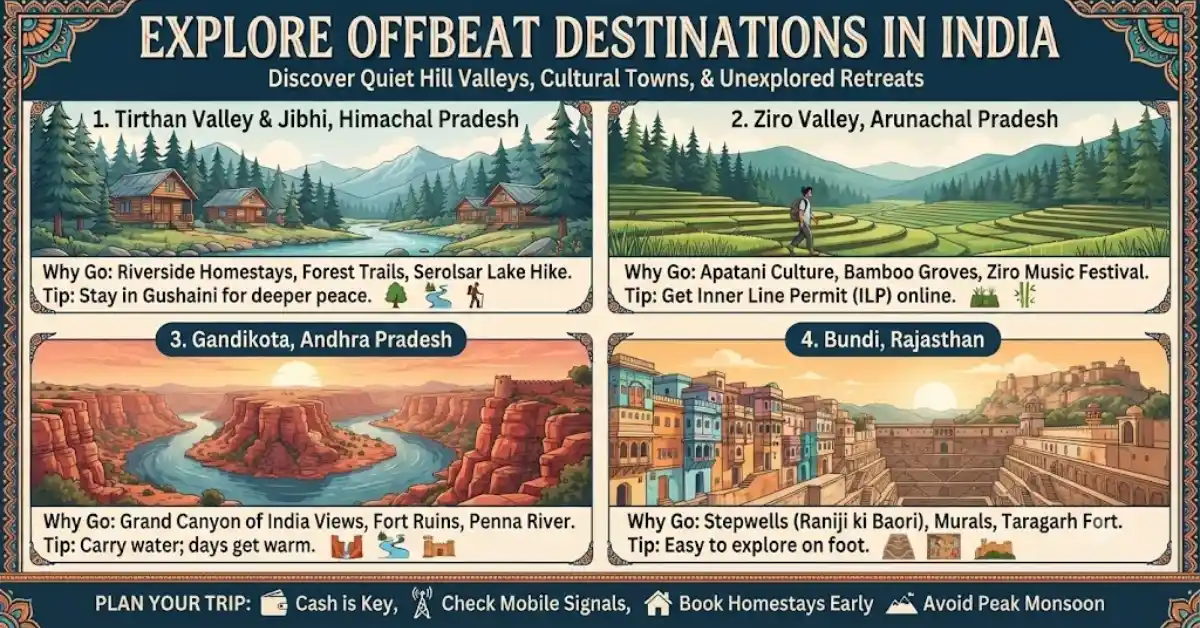
The best offbeat destinations in India include Tirthan Valley, Munsiyari, and Gurez Valley for quiet mountain stays. You can pick Ziro Valley, Majuli, and Khonoma for Northeast culture and nature. Valparai, Gandikota, and Chettinad work well for less crowded South Indian trips. For heritage and desert views, try Bundi or Dholavira. Most of these places offer homestays and daily budgets of about ₹2,000–₹4,500.
Key Takeaways
- Pick Homestays Over Big Hotels: Offbeat towns rarely have big hotel chains. Local family-run homestays give you home-cooked food, local route tips, and reliable heating or power backup.
- Plan for Final Road Travel Time: Remote places often need a 2-to-5-hour cab or shared Sumo ride from the nearest train station or airport. Always plan to arrive in daylight.
- Check Permits Before You Book: Trips to Arunachal Pradesh, Nagaland, Mizoram, Sikkim, and border valleys in Kashmir or Ladakh may need an Inner Line Permit (ILP) (a travel pass for certain protected or border areas) or local police sign-in.
- Carry Cash & Check Mobile Signals: UPI works in many small towns, but hill and border valleys often have weak data. Keep ₹2,000–₹3,000 in cash and carry a Jio, Airtel, or BSNL postpaid SIM where needed.
- Skip Peak Monsoon in the Hills: July and August bring heavy rain and landslide risks in Himachal Pradesh, Uttarakhand, and the Northeast.
Introduction
Popular holiday spots like Manali, Shimla, Ooty, and North Goa now see heavy weekend traffic, full hotels, and noisy viewpoints. If you want quiet mountain trails, calm tea gardens, living heritage towns, or slow village stays, going off the usual tourist route makes a big difference.
Still, visiting lesser-known places in India takes a bit more planning than a regular city trip. Buses and trains run less often, ATMs can run out of cash, and weather matters more. This guide covers 11 of the best offbeat destinations in India picked for real scenery, local culture, and practical access. You will also find nearby transit hubs, best months to visit, and realistic INR budgets.
Quick Comparison: Top Offbeat Destinations in India
| Destination | State / UT | Best For | Ideal Months | Est. Daily Budget (INR) | Nearest Major Transit Hub |
| Tirthan Valley & Jibhi | Himachal Pradesh | Riverside homestays, pine forests & treks | Mar – Jun, Sept – Nov | ₹2,000 – ₹3,800 | Chandigarh Jn / Bhuntar Airport |
| Munsiyari | Uttarakhand | Panchachuli peak views & alpine trails | Mar – Jun, Sept – Nov | ₹1,800 – ₹3,500 | Kathgodam (KGM) / Pantnagar Airport |
| Gurez Valley | Jammu & Kashmir | Wooden log villages, Kishanganga River | May – Oct | ₹2,500 – ₹4,500 | Srinagar Airport (SXR) / Jammu Tawi |
| Ziro Valley | Arunachal Pradesh | Pine hills, Apatani culture & paddy fields | Mar – May, Sept – Nov | ₹2,500 – ₹4,500 | Naharlagun (NHLN) / Hollongi Airport |
| Majuli | Assam | World’s largest river island & Satra culture | Oct – Mar | ₹1,800 – ₹3,200 | Jorhat Town / Jorhat Airport (JRH) |
| Khonoma | Nagaland | Asia’s first green village & terraced hills | Oct – Apr | ₹2,200 – ₹4,000 | Dimapur (DMV) / Dimapur Airport |
| Valparai | Tamil Nadu | Tea plantations, rainforests & wildlife | Sept – May | ₹2,200 – ₹4,200 | Pollachi / Coimbatore Jn (CBE) |
| Gandikota | Andhra Pradesh | Pennar River gorge & historic fort ruins | Oct – Feb | ₹1,500 – ₹3,000 | Muddanuru / Kadapa (HX) |
| Chettinad (Karaikudi) | Tamil Nadu | Heritage mansions, cuisine & temple crafts | Oct – Mar | ₹2,500 – ₹5,000 | Karaikudi Jn (KKDI) / Trichy Airport |
| Bundi | Rajasthan | Stepwells, murals, forts & quiet lakes | Oct – Mar | ₹1,500 – ₹3,000 | Kota Jn (KOTA) / Jaipur Airport |
| Dholavira | Gujarat | Harappan ruins & White Rann sunset road | Nov – Feb | ₹2,500 – ₹4,800 | Bhuj (BHUJ) / Bhuj Airport |
(Note: Daily budgets cover a homestay or guesthouse stay, local meals, and shared or local transport. Flights, long-distance trains, and multi-day private cabs cost extra.)
Best Offbeat Destinations in India by Region
Quiet Himalayan Valleys
1. Tirthan Valley & Jibhi, Himachal Pradesh
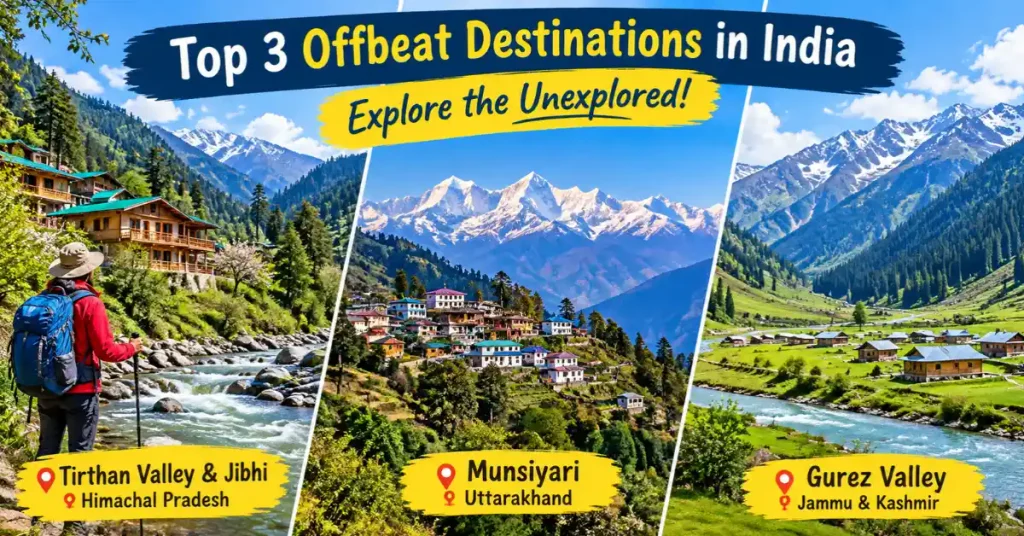
Sitting next to the Great Himalayan National Park (a UNESCO World Heritage Site), Tirthan Valley and nearby Jibhi offer wooden cottages, apple orchards, and clear trout streams. You get mountain charm without Manali’s highway jams.
- Why go: Enjoy quiet walks by the river, forest waterfalls (like Jibhi Waterfall and Chehni Kothi), and scenic day hikes to Serolsar Lake through Jalori Pass.
- How to reach: Take a night HRTC or private Volvo bus from Delhi toward Manali and get off at Aut Tunnel (about 10–11 hours). From Aut, Tirthan Valley and Jibhi are a 45-to-60-minute local bus or taxi ride away.
- Good to know: Jibhi gets crowded on long weekends. Stay a bit deeper inside Tirthan Valley (near Gushaini or Sai Ropa) for more peace.
2. Munsiyari, Uttarakhand
Located in Uttarakhand’s Pithoragarh district at about 2,200 metres, Munsiyari faces the snow-covered Panchachuli peaks. It gives you big mountain views without heavy tourist crowds.
- Why go: Watch sunrise over Panchachuli, do the moderate trek to Khaliya Top, see Birthi Falls, and enjoy warm Kumaoni Bhotiya village hospitality.
- How to reach: Take an overnight train from Delhi to Kathgodam (KGM). Then drive for about 9 to 10 hours via Almora and Chaukori. Breaking the drive with an overnight stay in Chaukori is often easier.
- Good to know: Roads in Kumaon have many turns. Do not drive after dark, and skip peak monsoon months (July–August).
3. Gurez Valley, Jammu & Kashmir
Located along the old Silk Route near the Line of Control, Gurez Valley has sharp peaks, high meadows, and wooden log houses along the green Kishanganga River.
- Why go: See Habba Khatoon Peak, Dawar village, and Tulail Valley, and enjoy fresh mountain air with far fewer crowds than Gulmarg or Pahalgam.
- How to reach: Fly to Srinagar (SXR) and drive about 4.5 to 5.5 hours (about 125 km) across Razdan Pass via Bandipora.
- Good to know: Heavy snow closes Gurez from November to April. Carry valid government photo ID for security checks. Use a postpaid SIM (Jio or Airtel), because prepaid SIMs from outside J&K do not work there.
Unexplored Northeast India
4. Ziro Valley, Arunachal Pradesh
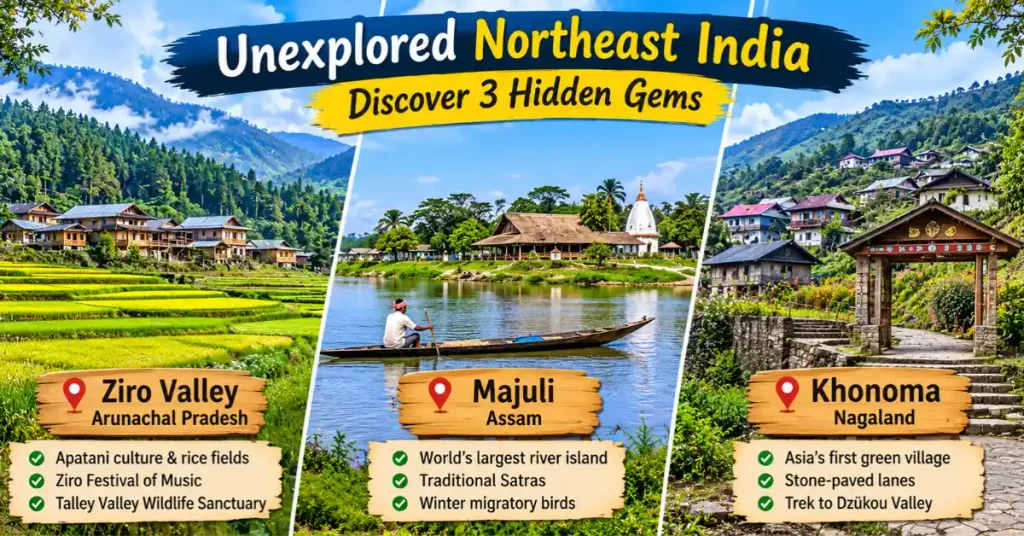
Surrounded by pine hills and stepped rice fields, Ziro Valley is home to the Apatani tribe, known for eco-friendly wet-rice and fish farming.
- Why go: Take slow walks through Hong and Hari villages, walk along bamboo groves, visit Talley Valley Wildlife Sanctuary, and check out the yearly Ziro Festival of Music (usually in September).
- How to reach: Take an overnight train from Guwahati to Naharlagun (NHLN) or fly to Donyi Polo Airport (Hollongi) near Itanagar. From there, take a 3.5-to-4-hour shared Sumo or cab ride to Ziro.
- Good to know: Indian citizens from outside Arunachal Pradesh must get an Inner Line Permit (ILP) online or at approved entry points before visiting.
5. Majuli, Assam
Set in the Brahmaputra River, Majuli is the world’s largest inhabited river island. It is also the cultural centre of Assam’s neo-Vaishnavite Satra (monastic) traditions.
- Why go: Join mask-making sessions at Samaguri Satra, watch traditional dance and music at Kamalabari and Auniati Satras, cycle past rice fields, and spot winter migratory birds.
- How to reach: Fly to Jorhat (JRH) or take a train to Mariani or Jorhat. Drive to Nimati Ghat, then take a government or private ferry across the Brahmaputra (about 1 to 1.5 hours).
- Good to know: Check morning and afternoon ferry times early, because river water levels change with the season.
6. Khonoma, Nagaland
About 20 km west of Kohima, Khonoma is known as Asia’s first green village. The Angami Naga community stopped hunting and logging here to protect local forests and wildlife.
- Why go: Walk stone-paved village lanes with a guide, see old ceremonial gates and stepped alder-tree farms, and take day hikes toward Dzükou Valley.
- How to reach: Fly or take a train to Dimapur (DMV). Drive 2.5 to 3 hours to Kohima, then take a local cab (about 45 minutes) to Khonoma.
- Good to know: Indian visitors need an Inner Line Permit (ILP) to enter Nagaland. Stay in a family-run Angami homestay to try local food and hear local stories.
Offbeat South India
7. Valparai, Tamil Nadu
High in the Anaimalai Hills of the Western Ghats, Valparai is a calm hill town surrounded by green tea estates, misty bends, and tropical rainforests.
- Why go: Spot rare lion-tailed macaques and Nilgiri tahr, visit Sholayar Dam and Nallamudi Viewpoint, and stay in old tea bungalows.
- How to reach: Fly or take a train to Coimbatore (CBE). Then drive about 3.5 hours (105 km) via Pollachi and the scenic 40-hairpin-bend ghat road.
- Good to know: Valparai sits next to Anamalai Tiger Reserve.Avoid travelling along forest roads after sunset.
8. Gandikota, Andhra Pradesh
Often called the Grand Canyon of India, Gandikota has a deep gorge cut by the Pennar River next to an old 13th-century red sandstone fort.
- Why go: Watch sunrise and sunset over the Pennar Gorge, explore Madhavaraya and Ranganatha temples inside the fort, and visit nearby Belum Caves (about 60 km away).
- How to reach: Take an overnight train from Hyderabad or Bengaluru to Kadapa (HX) or Muddanuru. Then hire a local auto or cab for the final stretch.
- Good to know: Stays inside Gandikota are simple (APTDC Haritha Resort and local homestays). Carry sunscreen, a cap, and plenty of water, as days stay warm most of the year.
9. Chettinad (Karaikudi), Tamil Nadu
Many visitors to Tamil Nadu go only to Madurai or Thanjavur. Around Karaikudi, the Chettinad region offers rich merchant history, grand mansions, and bold, spicy food.
- Why go: Tour 19th-century Chettiar mansions built with Burmese teak and Italian marble, browse antique shops in Karaikudi, see Athangudi handmade tiles being made, and eat traditional Chettinad meals on banana leaves.
- How to reach: Karaikudi Junction (KKDI) has direct train links to Chennai, Madurai, and Rameswaram. Tiruchirappalli (Trichy) Airport is about 90 km away.
- Good to know: Several heritage mansions run as boutique heritage hotels. Some welcome day visitors for guided tours or traditional lunches if you book ahead.
Cultural & Heritage Gems in West & North India

10. Bundi, Rajasthan
Located just 38 km from Kota, Bundi is a charming heritage town known for its beautiful lakes, historic palaces, and ancient stepwells. It offers a quieter Rajasthan experience without the heavy tourist crowds found in Jaipur and Udaipur.
- Why Visit: Discover the historic Taragarh Fort, Garh Palace, famous for its traditional Bundi-style wall paintings, and Raniji ki Baori (Queen’s Stepwell). You can also enjoy peaceful evening strolls along Nawal Sagar Lake.
- How to Reach: Take a train to Kota Junction (KOTA) on the Delhi–Mumbai railway route. From Kota, Bundi is around 45 minutes away by taxi or state-run bus.
- Good to Know: Bundi is a compact town that is easy to explore on foot. You may also spot playful langurs around the palace rooftops, so keep your belongings secure.
11. Dholavira, Gujarat
Situated on Khadir Bet Island in the Great Rann of Kutch, Dholavira is one of the most significant archaeological sites of the Indus Valley (Harappan) Civilization and a UNESCO World Heritage Site.
- Why Visit: Explore 4,500-year-old stone water reservoirs, ancient city gates, and impressive ruins of the Harappan settlement. You can also drive along the spectacular Road to Heaven, a scenic causeway surrounded by vast white salt flats.
- How to Reach: Travel by flight or train to Bhuj (BHUJ). From there, Dholavira is approximately 215 km away, taking around 4–4.5 hours by road via Bhachau and Rapar.
- Best Time to Visit: November to February is ideal, as the winter weather is pleasant and the surrounding salt desert is generally dry.
How to Plan a Hassle-Free Offbeat Trip in India
- Choose Your Main Travel Hub: Identify the nearest major railway station or airport using IRCTC and other travel services. Check the road travel time to your final destination before booking non-refundable accommodation.
- Reserve Local Homestays in Advance: Remote villages often have limited accommodation, with only 10–20 quality rooms available. Contact your host after booking to confirm road conditions, heating or air-conditioning facilities, and meal timings.
- Check Permit and ID Requirements Early: Apply for Inner Line Permits (ILPs) for destinations in Arunachal Pradesh, Nagaland, or Mizoram at least 1–2 weeks before your trip. Carry printed permit copies along with your original government-issued ID or passport.
- Download Offline Maps and Carry Cash: Save your Google Maps route for offline use before leaving the nearest major town. Keep around ₹2,000–₹3,000 in cash, preferably in smaller denominations such as ₹100, ₹200, and ₹500 notes.
- Pack Smart and Respect Local Traditions: Carry layered clothing for changing mountain weather. Avoid single-use plastics in environmentally sensitive areas and always seek permission before photographing local residents or religious ceremonies.
Common Mistakes to Avoid When Visiting Offbeat Destinations
- Expecting Late-Night Services: Many village homestays and small guesthouses close their kitchens by 8:30 PM or 9:00 PM. Inform your host about your dinner plans in the late afternoon to avoid inconvenience.
- Underestimating Mountain Travel Times: In Uttarakhand, Himachal Pradesh, Kashmir, and Northeast India, covering 120 km on hilly roads can take 4–5 hours. Avoid booking tight flight connections on the same day you return from a remote valley.
- Overlooking Mobile Network Coverage: Prepaid SIM cards from other states may not work in Jammu & Kashmir or Ladakh. In remote areas of the Northeast and Kumaon, BSNL or Jio may offer better connectivity than other networks.
READ ALSO:-Best 10 Places for Solo Travellers in India: Safe, Budget-Friendly & Easy-to-Navigate Destinations
FAQ
What is the top offbeat destination to explore in India?
The ideal offbeat destination varies depending on your travel preferences and interests. Tirthan Valley (Himachal Pradesh) and Munsiyari (Uttarakhand) are great for quiet mountain views and homestays. Ziro Valley and Majuli stand out for Northeast culture, while Chettinad and Bundi suit uncrowded heritage and food.
Are Offbeat Destinations in India Safe for Families and Solo Travellers?
Yes, most well-known offbeat places—like Tirthan Valley, Valparai, Majuli, Bundi, and Chettinad—are safe and welcoming for families and solo travellers. Pick trusted family-run homestays, use reliable local drivers, and avoid driving on mountain roads at night.
Which are the best offbeat places near Delhi for a long weekend?
Tirthan Valley & Jibhi (Himachal Pradesh), Bundi (Rajasthan), and Chaukori or Binsar (Uttarakhand) are good picks from Delhi. You can reach them by overnight train or Volvo bus plus a short road ride, making them fit well into a 3-to-4-day break.
Which offbeat destinations in South India are worth exploring?
Valparai (Tamil Nadu), Gandikota (Andhra Pradesh), Chettinad (Tamil Nadu), and Gokarna or Agumbe (Karnataka) offer calm scenery, heritage spots, and fewer crowds than Ooty, Munnar, or Coorg.
How to Explore Offbeat Destinations in India Without a Personal Vehicle?
Take an IRCTC train or state bus to the nearest district town (like Kathgodam, Kota, Jorhat, Dimapur, or Coimbatore). From there, use local shared Sumos, state buses, or a cab booked through your homestay host for the last stretch.
Do You Need Special Permits to Visit Offbeat Destinations in Northeast India?
Yes, Indian domestic travellers need an Inner Line Permit (ILP) to visit Arunachal Pradesh, Nagaland, Mizoram, and Manipur. Assam and Meghalaya do not need an ILP for Indian citizens. Always check current permit rules on official state tourism websites before your trip.
What Is the Ideal Season to Explore Offbeat Destinations in India?
October to March is the best time overall for offbeat places in Rajasthan, Gujarat, South India, and Assam. For mountain valleys in Himachal Pradesh, Uttarakhand, Kashmir, and Arunachal Pradesh, March to June and September to November usually bring clearer weather and safer roads.