

Bihar holds great historical and religious importance as a region deeply connected to the development of Buddhism and Jainism. It was also the political center of the ancient Mauryan and Gupta Empires. From the quiet peace of the Mahabodhi Temple to the ancient ruins of Nalanda and the green forests of Valmiki Tiger Reserve, Bihar has deep cultural, spiritual, and historical roots.
If you are planning a weekend pilgrimage, a family vacation, or a nature trip, this guide covers the top 10 tourist places in Bihar.
Quick Reference: Top 10 Destinations at a Glance
Explore Bihar’s best tourist destinations, their main attractions, ideal travel experiences and recommended visiting duration.
| Destination | Main Attraction | Best For | Nearest Station / Airport | Recommended Duration |
|---|---|---|---|---|
| Bodh Gaya | Mahabodhi Temple & Bodhi Tree | Spiritual peace, UNESCO heritage | Gaya Junction (16 km) / Gaya Airport | 2 Days |
| Nalanda | Nalanda Mahavihara Ruins | Ancient history, architecture | Rajgir / Nalanda Station (87 km from Patna) | 1 Day |
| Rajgir | Vishwa Shanti Stupa & Glass Bridge | Ropeway, hot springs, trekking | Rajgir Railway Station (RGD) | 2 Days |
| Patna | Takht Sri Patna Sahib & Bihar Museum | Heritage, Sikh pilgrimage, culture | Patna Junction / Jay Prakash Narayan Airport | 1–2 Days |
| Vaishali | Ashokan Pillar & Relic Stupa | Ancient democracy, Buddhist/Jain history | Hajipur Junction (35 km) | 1 Day |
| Sasaram | Sher Shah Suri Tomb | Indo-Islamic architecture | Sasaram Junction (SSM) | 1 Day |
| Valmiki National Park | Tiger Reserve & Sal Forests | Wildlife safaris, jungle trails | Narkatiaganj Junction / Bagaha | 2–3 Days |
| Pawapuri | Jal Mandir | Jain pilgrimage, quiet atmosphere | Pawapuri Road / Bihar Sharif | Half Day |
| Vikramshila | Ancient University Ruins & Stupa | Archaeological exploration | Kahalgaon / Bhagalpur Junction | 1 Day |
| Kakolat Falls | Natural Waterfall Pool & Forest | Picnics, freshwater bathing | Nawada Railway Station (33 km) | 1 Day |
Note: Distances and travel times may vary depending on your starting point and route. Check current transport availability before travelling.
1. Bodh Gaya: The World Center of Buddhist Enlightenment
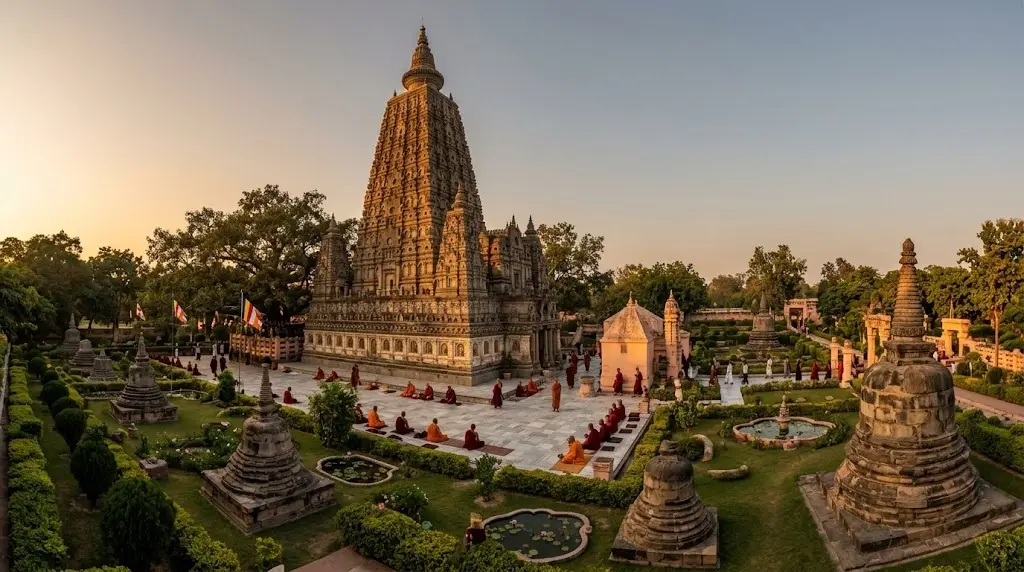
Bodh Gaya is one of the most important Buddhist pilgrimage destinations in the world. Situated in Gaya district of Bihar, the town is close to the Falgu River Prince Siddhartha Gautama meditated here under the Bodhi Tree around 500 BCE, reached enlightenment, and became the Buddha.
Core Highlights:
Mahabodhi Temple Complex: This UNESCO World Heritage Site is famous for its magnificent central tower, which stands approximately 55 metres tall.
The Sacred Bodhi Tree: The descendant of the original sacred fig tree (peepal) where the Buddha meditated.
80-Foot Great Buddha Statue: A tall sandstone statue unveiled by the 14th Dalai Lama.
International Monasteries: Colorful monasteries built by Buddhist communities from Thailand, Bhutan, Japan, Sri Lanka, and Tibet.
Travel Tips:
- Entry & Timings: The temple stays open from 5:00 AM to 9:00 PM. Entry is free. Mobile phones and electronics are not allowed inside the main sanctum, but you can leave them in secure cloakrooms outside.
- How to Reach: It is 16 km from Gaya Airport and 17 km from Gaya Junction railway station. You can take auto-rickshaws, app cabs, or taxis directly from Gaya.
2. Nalanda Mahavihara: The Ancient University
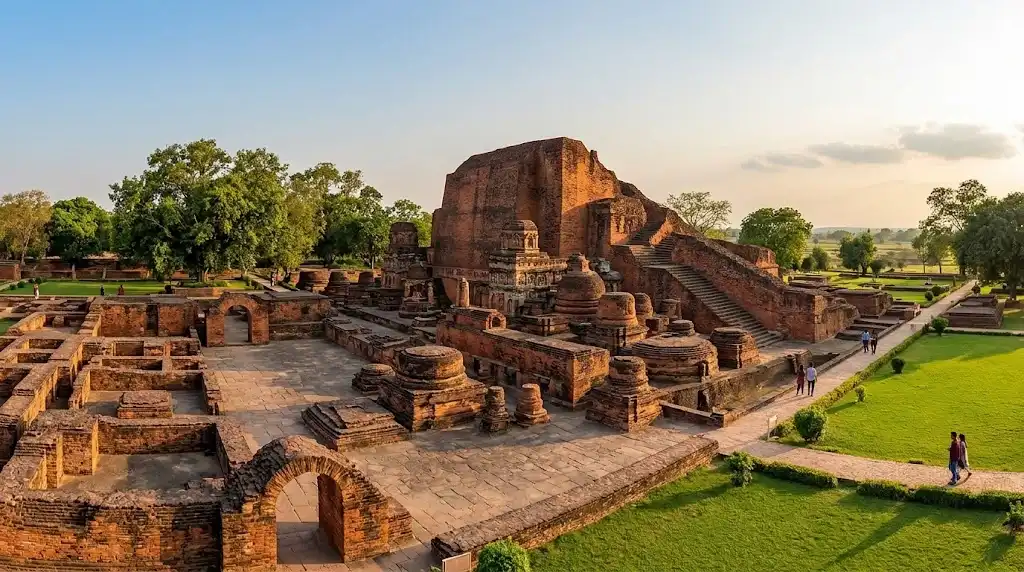
Established in the 5th century CE under the Gupta dynasty, Nalanda became one of the earliest known residential centres of higher learning in the world. It once hosted over 10,000 students and 2,000 teachers from India, China, Korea, Tibet, and Central Asia. Today, it is a protected UNESCO World Heritage Site with well-preserved red-brick ruins.
Core Highlights:
Temple No. 3: A large stepped stupa (a dome-shaped Buddhist monument) offering wide views across the campus.
Monastery Rooms & Kitchens: Ancient classrooms, student living quarters, grain storage rooms, and an underground drainage system.
Nalanda Archaeological Museum: Displays ancient stone statues, bronze figures, coins, and seals found during excavations.
Hiuen Tsang (Xuanzang) Memorial Hall: A pagoda-style memorial built in honor of the famous 7th-century Chinese scholar who studied and taught here.
Travel Tips:
- Entry Fees: ₹50 for Indian visitors (cheaper if booked online via the ASI portal) and ₹300 for foreign tourists. Children under 15 enter free.
- Location: Nalanda is approximately 15 km from Rajgir and around 90 km from Patna. Consider hiring an ASI-licensed guide at the gate to explain the campus layout.
3. Rajgir: The Ancient Capital of Magadha
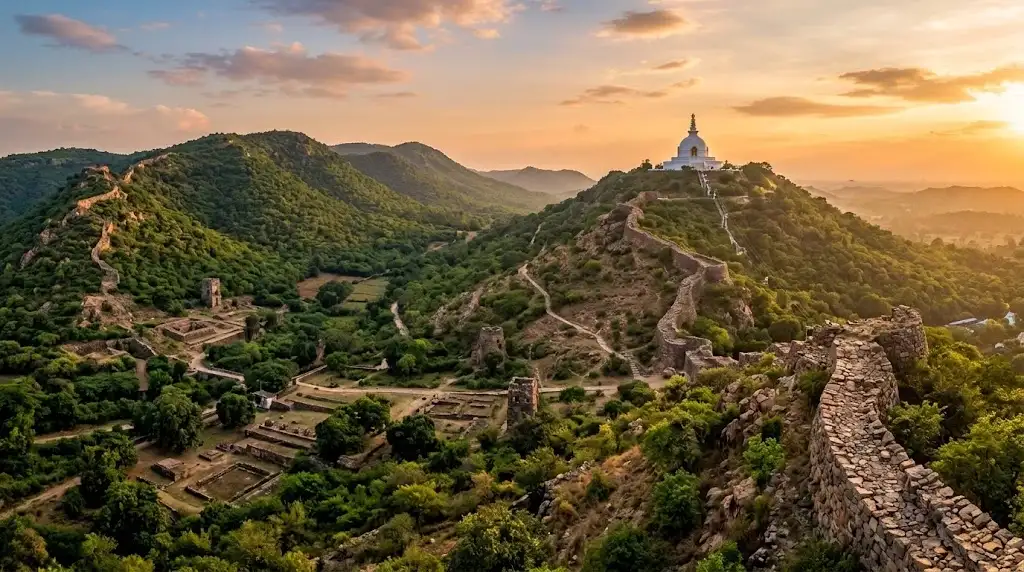
In the past, Rajgir was known as Rajagriha and served as the earliest capital of the powerful Magadha Empire. It sits inside a valley surrounded by seven hills: Vibhargiri, Ratnagiri, Chaithagiri, Sonagiri, Udaygiri, Vaibhargiri, and Vipulachala. It is sacred to both Buddhists and Jains and is a hub for eco-tourism.
Core Highlights:
Vishwa Shanti Stupa (Peace Pagoda): This beautiful white Buddhist monument is located at the summit of Ratnagiri Hill. You can reach it by chairlift ropeway or by climbing stone steps.
Griddhakuta (Vulture’s Peak): The hill site where Gautama Buddha taught key sermons, including the Heart Sutra.
Rajgir Nature Safari & Glass Skywalk: An 85-foot-high glass bridge suspended over a valley, along with zip-lining and cycling routes.
Brahmakund Hot Springs: Natural sulfur hot water springs at the foot of Vaibhava Hill.
Cyclopean Wall: Remnants of an ancient 40-km dry stone defense wall that once circled the city.
Travel Tips:
- Best Time to Visit: October to March. Summer temperatures can cross 42°C.
- Booking: Book tickets for the Glass Bridge and Nature Safari online through the Bihar Forest Department website to avoid long weekend queues.
4. Patna: Where Ancient Pataliputra Meets Modern Life
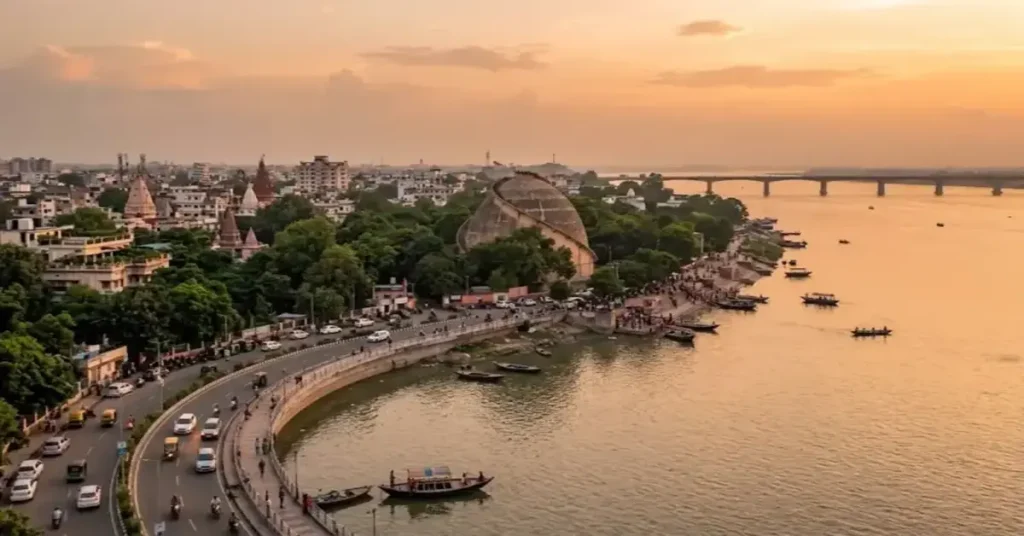
Patna, the capital city of Bihar, is situated along the southern banks of the Ganga River. Known in ancient times as Pataliputra, it served as the royal seat of Emperor Ashoka and Chandragupta Maurya.
Core Highlights:
Takht Sri Patna Sahib: A major pilgrimage site for Sikhs, this sacred place is among Sikhism’s five Takhts and is where Guru Gobind Singh Ji was born.
The Bihar Museum: A modern 13-acre museum displaying ancient artifacts, including the famous Didarganj Yakshi sandstone statue and children’s activity galleries.
Golghar: A hive-shaped granary built in 1786 by Captain John Garstin to store grain after famines. A spiral exterior staircase leads to river views.
Marine Drive (Ganga Path): A riverside road along the Ganga, popular for evening walks and scenic drives.
Travel Tips:
- Transit Hub: Patna connects to the rest of the state. It has direct flights to major cities like Delhi, Mumbai, Bengaluru, Kolkata, and Hyderabad.
5. Vaishali: An Ancient Republic
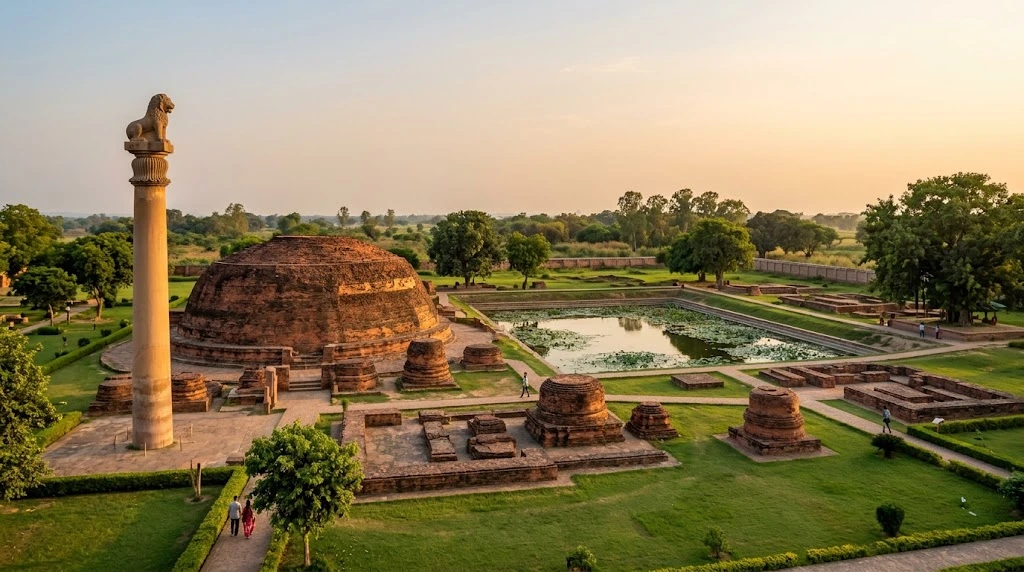
Vaishali was the capital of the Licchavi clan and is considered one of the world’s earliest republics with an elected assembly. Lord Mahavira was born at nearby Kundagrama, and Lord Buddha gave his last sermon here before passing away at Kushinagar.
Core Highlights:
Ashokan Pillar at Kolhua: A single-stone red sandstone pillar with an intact lion carving on top. It stands beside a brick stupa and an ancient pond (Markata-Hrada).
Buddha Relic Stupa: The mud-and-brick stupa site where archaeologists excavated a portion of Lord Buddha’s cremated ashes.
Vishwa Shanti Stupa & Abhishek Pushkarini: A white peace pagoda overlooking the sacred pond used for coronations by ancient Licchavi leaders.
Travel Tips:
- Distance: Located 55 km north of Patna. You can visit it as a half-day trip by driving across the Mahatma Gandhi Setu over the Ganga.
6. Sasaram: Sher Shah Suri’s Lake Tomb
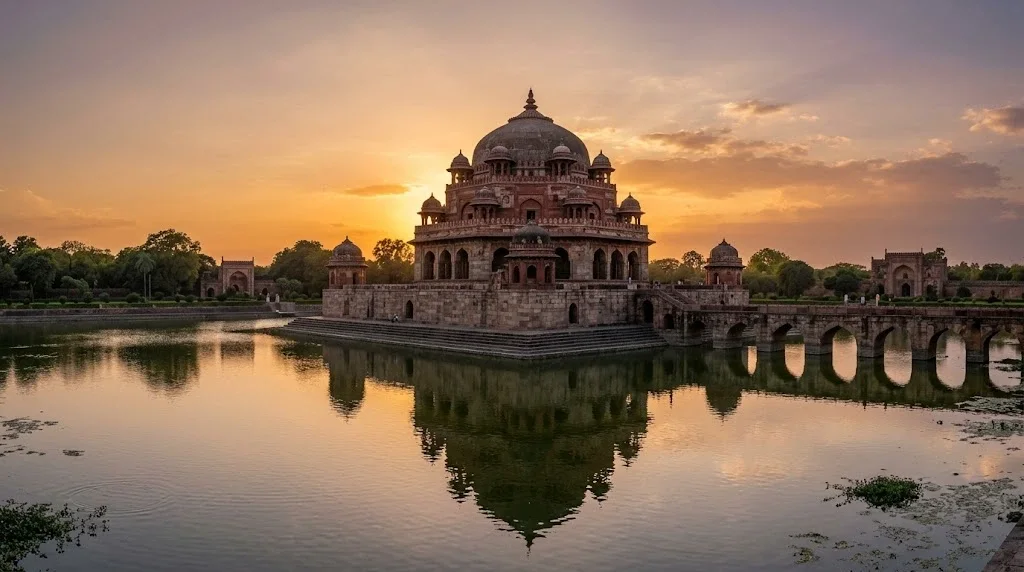
Sasaram is a historic city in southwestern Bihar. It is home to one of India’s finest examples of Indo-Islamic tomb architecture.
Core Highlights:
Tomb of Sher Shah Suri: Built in 1545 CE, this red sandstone octagonal tomb stands on a stone platform in the center of an artificial lake. It reflects the architectural shift from the Lodi period to the beginnings of Mughal design.
Rohtasgarh Fort: A large hill fortress on the Kaimur Plateau nearby, featuring ancient stone gateways like Hathiya Pol and the ruins of Aina Mahal palace.
Travel Tips:
- How to Reach: Sasaram Junction sits on the main Delhi–Kolkata Grand Chord rail line. The town is also accessible by road along NH 19 (Grand Trunk Road).
7. Valmiki National Park: Terai Forest & Wildlife
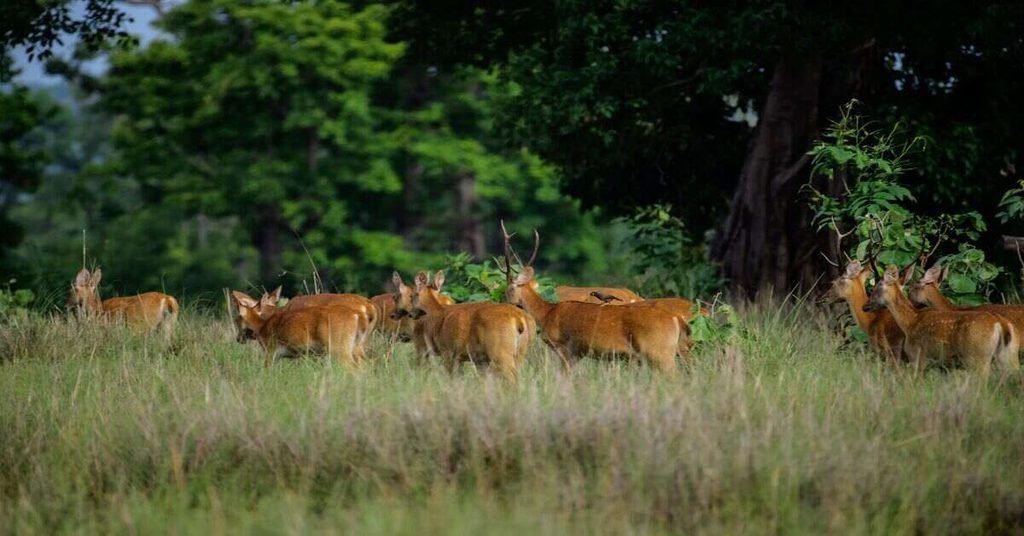
Valmiki National Park, located in West Champaran, is the only designated tiger reserve in Bihar. It sits along the India–Nepal border with the Shivalik hills in the background.
Core Highlights:
Wildlife Safaris: Home to Bengal tigers, leopards, one-horned rhinos, sloth bears, barking deer, and over 250 species of birds.
Gandak River & Triveni Ghat: A scenic riverfront border area next to Nepal’s Chitwan National Park, known for boat rides.
Sal Forests: Stretches of dense sal, cane, and mixed deciduous jungle.
Travel Tips:
- Safari Season: Open from November to May. The park is closed during the monsoon.
- Where to Stay: The forest department runs eco-cottages, tent camps, and bamboo huts at Valmikinagar.
8. Pawapuri: The Island Temple of Jainism
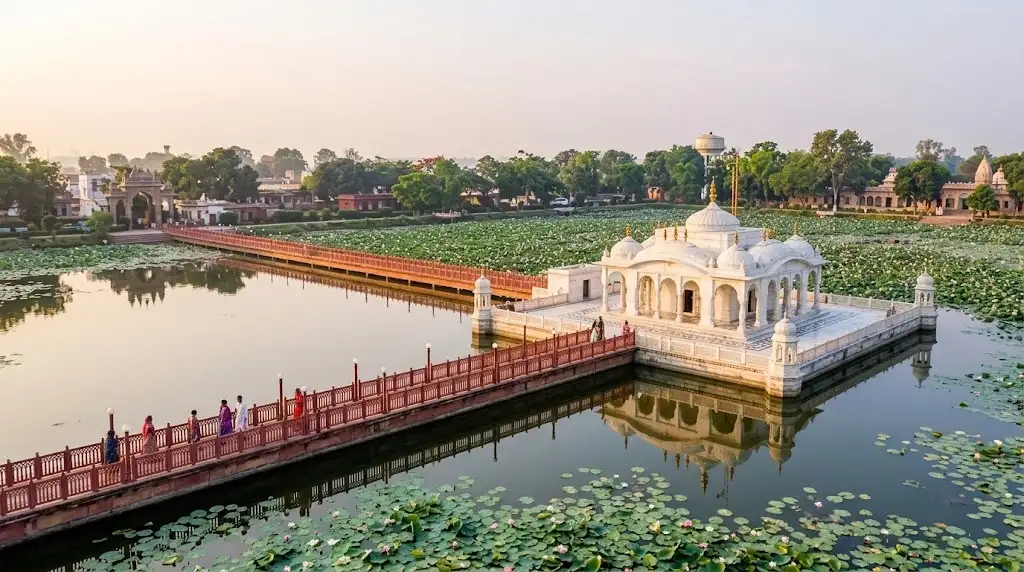
Located in Nalanda district, Pawapuri (also known as Apapapuri, the “sinless town”) is a key pilgrimage spot for Jains. The 24th Tirthankara, Lord Mahavira, achieved Moksha (liberation from the cycle of rebirth) here in 527 BCE.
Core Highlights:
Jal Mandir: This beautiful temple, built from white marble, stands on an island surrounded by a lake filled with lotus flowers. A 600-foot red sandstone bridge connects the temple to the shore.
Gaon Mandir: A town temple marking the spot where Lord Mahavira delivered his final sermon.
Travel Tips:
Route: Pawapuri is just 18 km east of Rajgir, so you can easily combine it with your Nalanda and Rajgir tour. You must take off your shoes and leave leather items behind before crossing the footbridge.
9. Vikramshila University Ruins: Remains of a Historic Buddhist Learning Centre
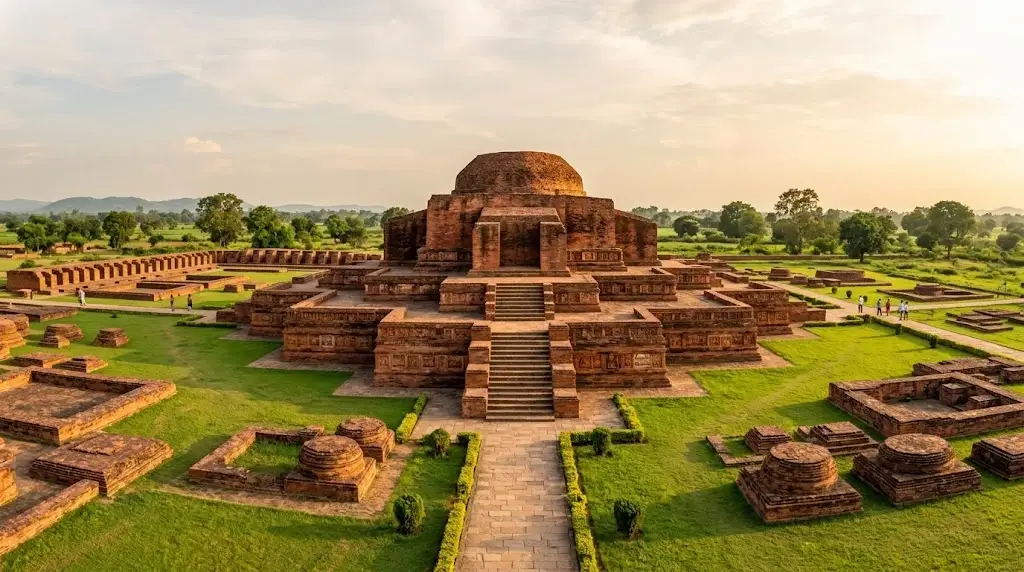
Vikramshila sits at Antichak in Bhagalpur district. King Dharmapala of the Pala dynasty set up the university in the late 8th century CE to support Buddhist education alongside Nalanda. It became a prominent center for Vajrayana (Tantric) Buddhist teachings.
Core Highlights:
Central Stupa: A two-level brick stupa with terracotta plaques that show scenes of daily 9th-century life, animals, and spiritual figures.
Monastery Cells: Over 200 underground rooms where student monks once lived and studied.
Vikramshila Archaeological Museum: Displays stone sculptures, carved plaques, and ancient artifacts discovered during site digs.
Travel Tips:
- Nearby Sights: You can pair this visit with the Vikramshila Gangetic Dolphin Sanctuary in Bhagalpur, India’s protected river area for endangered river dolphins.
10. Kakolat Waterfall: Natural Hill Springs
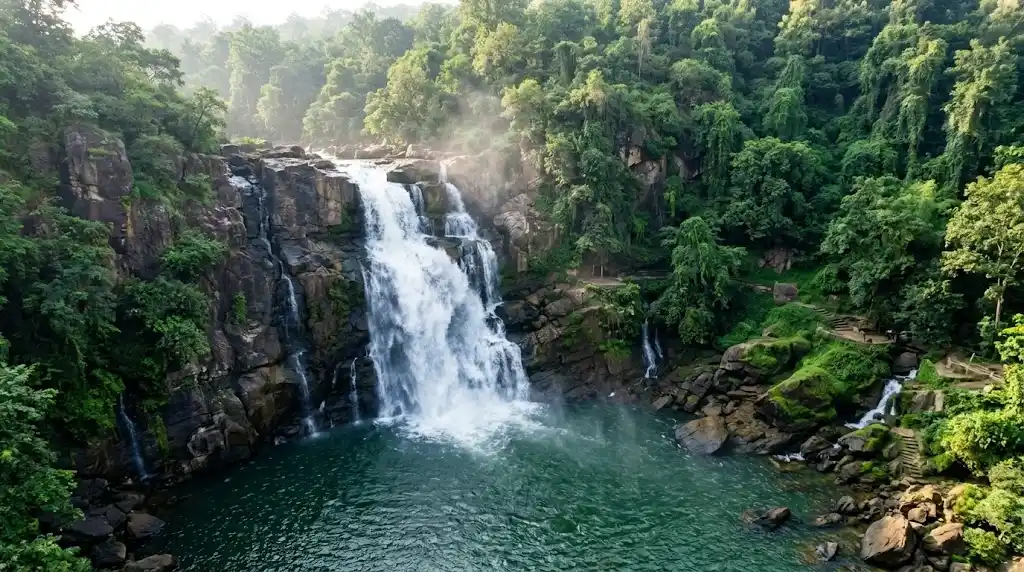
Kakolat Falls sits in Govindpur block in Nawada district, near the Bihar–Jharkhand border. It is a well-known outdoor picnic spot.
Core Highlights:
The Waterfall Pool: Cool spring water drops from a height of 150 to 160 feet into a natural rock pool surrounded by green hills.
Local Legends: Folklore connects the pool to the Mahabharata, stating that the Pandava brothers stayed here during their exile.
Travel Tips:
- Facilities: The area now has paved stairs, changing rooms, safety railings, and food stalls.
- Safety Tip: Avoid bathing in the pool during heavy monsoon rains, as water levels can rise quickly.
Thematic Travel Recommendations
Best Religious Places in Bihar
Mahabodhi Temple (Bodh Gaya): The world center of Buddhism.
Takht Sri Patna Sahib (Patna): The sacred birthplace of the tenth Sikh Guru, Guru Gobind Singh Ji.
Vishnupad Temple (Gaya): Ancient stone temple housing Lord Vishnu’s footprint; central site for Pitrapaksh Shraddha rituals.
Jal Mandir (Pawapuri): Sacred Jain site marking Lord Mahavira’s nirvana.
Maa Mangla Gauri Mandir (Gaya): One of the 18 Maha Shaktipeeth temples.
Best Historical Places to Visit in Bihar
- Nalanda Mahavihara Ruins: 5th-century residential university.
- Barabar Caves (Jehanabad): India’s oldest rock-cut caves, dating back to the Mauryan era, known for mirror-polished granite walls and echo chambers.
- Sher Shah Suri Tomb (Sasaram): Unique sandstone tomb built in the center of an artificial lake.
- Rohtasgarh Fort: Large hilltop fort overlooking the Sone River valley.
- Kesariya Stupa (East Champaran): One of the world’s tallest Buddhist brick stupas.
Best Day Trips from Patna
- Vaishali (55 km): Cross Gandhi Setu to see Ashokan pillars and ancient stupas (about 1.5 hours by car).
- Nalanda & Rajgir (85–100 km): Travel via the NH 31 / NH 120 highway (about 2.5 hours by car).
- Maner Sharif (30 km): Sandstone tombs of Sufi saints Makhdoom Yahya Maneri and Shah Daulat.
Visiting Bihar in Winter
- Winter (November to February) is the best time to tour Bihar. Day temperatures stay between 10°C and 25°C. This makes outdoor walking across Nalanda, taking the open Rajgir ropeway, or going on a safari at Valmiki National Park comfortable.
Travel Costs, Safety & Food
1. Estimated Daily Budget (Per Person)
- Budget Travelers: ₹1,200 – ₹1,800 per day (staying in state tourist bungalows, dharamshalas, or budget hotels; using shared autos and local buses).
- Mid-Range Travelers: ₹3,500 – ₹5,500 per day (3-star hotels in Patna or Bodh Gaya, AC rental cars, entry tickets, and restaurant meals).
- Luxury Travelers: ₹8,000+ per day (5-star hotels like Hotel Maurya or Taj City Centre in Patna, boutique resorts in Bodh Gaya, private SUVs).
2. Popular Local Food
- Litti Chokha: Baked wheat balls stuffed with spiced sattu (roasted gram flour), dipped in ghee, and served with roasted brinjal and tomato mash.
- Silao Ka Khaja: A crisp, layered sweet pastry from Silao (near Nalanda), recognized with a Geographical Indication (GI) tag.
- Tilkut & Anarsa: Traditional sweets made of sesame seeds and jaggery, popular during winter in Gaya.
3. Practical Tips & Safety
- Safety: Major tourist corridors (Patna, Bodh Gaya, Rajgir, Nalanda) are safe for solo travelers and families. Highways are regularly patrolled. As with any travel destination, avoid driving alone through unfamiliar rural roads late at night.
- Payments: UPI apps (PhonePe, Google Pay, Paytm) work at most places, including small food stalls. Keep ₹500 to ₹1,000 in cash when heading into forest areas like Kakolat or Valmiki.
- Monument Tickets: Book entry tickets for ASI monuments (Nalanda, Sasaram, Kolhua) online on the ASI website to avoid standing in line at ticket counters.
READ ALSO:-Top 5 Places to Visit in Kerala: Ultimate Travel Guide & Trip Cost
Frequently Asked Questions
Which is the most famous tourist place in Bihar?
Bodh Gaya is one of Bihar’s most popular destinations, attracting visitors and pilgrims from across the world. It is home to the UNESCO World Heritage Mahabodhi Temple and the sacred Bodhi Tree, drawing pilgrims and travelers from around the world.
Why is Vaishali famous?
Vaishali is famous for its ancient republic, Buddhist heritage, Jain history, and its connection with Lord Buddha and Lord Mahavira.
How Much Time Should You Plan for Exploring Bihar’s Historical Sites?
A 4-to-5-day trip is enough to cover Bihar’s main heritage circuit: Patna (1 day), Nalanda and Pawapuri (1 day), Rajgir (1 to 2 days), and Bodh Gaya (1 to 2 days).
Can Families and Solo Visitors Travel Safely in Bihar?
Yes. Popular tourist centers like Patna, Nalanda, Rajgir, and Bodh Gaya receive regular domestic and foreign tourists. Roads are well-connected, tourist police are present at major monuments, and hotels are easily available. Basic safety precautions apply.
Which Season Is Ideal for Visiting Bihar?
The best time to visit is between October and March. The weather is cool and sunny, which is ideal for sightseeing, safaris, and outdoor walks.
What are the best places in Bihar for couples?
Rajgir is a popular choice for couples thanks to its scenic hills, the chairlift ropeway, the Glass Skywalk, and quiet resorts. The quiet monasteries of Bodh Gaya and the river promenade at Patna’s Marine Drive are also good options.